BioClear: A Modern, Conservative Way to Close “Black Triangles” and Refresh Your Smile
If you’ve noticed small dark gaps near your gumline (“black triangles”), spaces between teeth, or worn/chipped edges,
you’ve probably looked into veneers or traditional bonding. BioClear (often called the Bioclear Method) is a modern
composite dentistry technique designed to reshape teeth in a highly polished, seamless way—often with little to no drilling.
Disclaimer: This article is for general information only and isn’t a substitute for professional dental advice. Always consult a licensed dentist for diagnosis and treatment options.
What is BioClear?
BioClear is both the name of a company and a technique used in restorative and cosmetic dentistry.
The method uses thin, clear, anatomical matrices (molds) and a “warm injection molding” approach with composite resin
to create smooth, continuous restorations that blend naturally with the tooth.

Credit: Hussien A.O.T. et al., BMC Oral Health (2023), CC BY 4.0.
Source: https://pmc.ncbi.nlm.nih.gov/articles/PMC10276469/ • License: https://creativecommons.org/licenses/by/4.0/
What concerns can BioClear help with?
- Black triangles (open gingival embrasures near the gumline)
- Small gaps between teeth (diastema)
- Worn or chipped edges (especially front teeth)
- Minor shape concerns (uneven edges, narrow teeth, small “peg laterals”)
- Replacing old bonding or smoothing rough/irregular surfaces
Not every case is a perfect fit. If teeth are severely misaligned, heavily damaged, or require major bite changes,
other options (orthodontics, crowns, veneers, etc.) may be more appropriate.
How does the BioClear technique work?
Exact steps vary by dentist, but BioClear is commonly described as a structured approach built around:
meticulous cleaning (biofilm removal), modern prep design (often very conservative), specialized clear matrices,
warm injection molding of composite, and a high-gloss polish.
Step-by-step (simplified)
- Consultation & smile planning: Your dentist evaluates spacing, gum health, bite, and shade.
- Deep cleaning of the tooth surface: A clean surface helps bonding durability and stain resistance.
- Isolation: Many dentists use isolation (often a rubber dam) to keep the area dry.
- Matrix selection & placement: Clear, anatomical matrices are fitted around the teeth to create the ideal shape.
- Etch, bond, and warm injection molding: Composite is warmed for better flow and injected/packed into the matrix to form a smooth, continuous restoration.
- Light curing: The composite is hardened with a curing light.
- Finishing & “rock-star polish”: Contouring and polishing create a glossy, enamel-like surface.

Credit: Hussien A.O.T. et al., BMC Oral Health (2023), CC BY 4.0.
Source: https://pmc.ncbi.nlm.nih.gov/articles/PMC10276469/ • License: https://creativecommons.org/licenses/by/4.0/

Credit: Hussien A.O.T. et al., BMC Oral Health (2023), CC BY 4.0.
Source: https://pmc.ncbi.nlm.nih.gov/articles/PMC10276469/ • License: https://creativecommons.org/licenses/by/4.0/
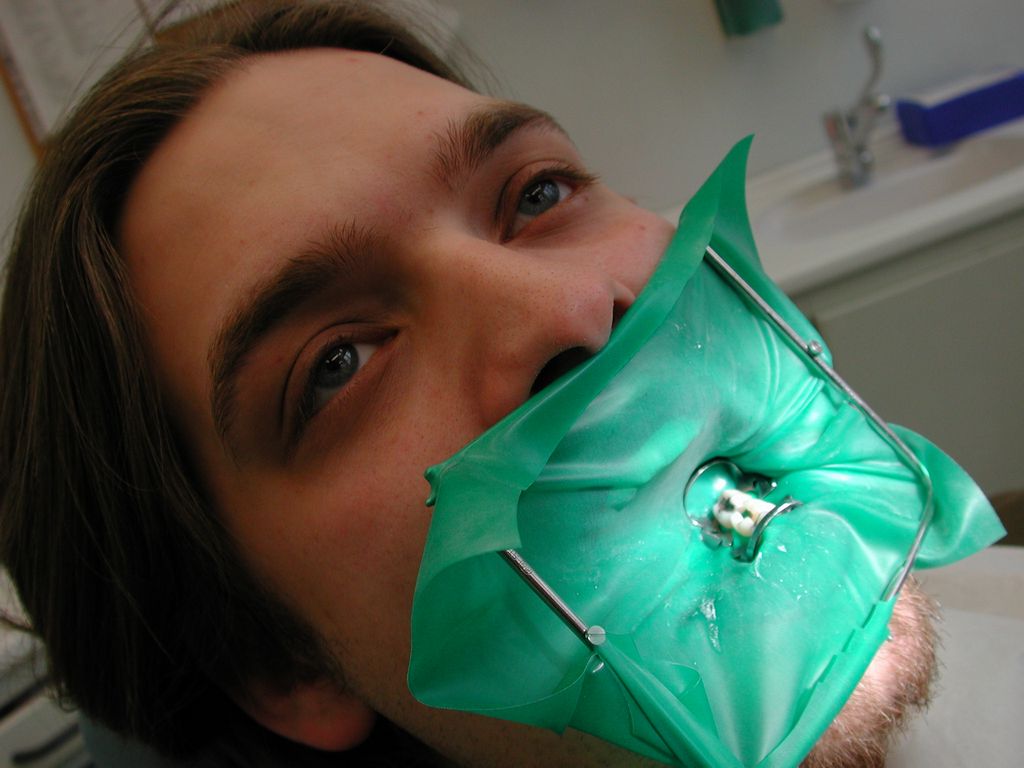
Credit: Alen Vlahovic, CC BY-SA 3.0 (via Wikimedia Commons).
File page: https://commons.wikimedia.org/wiki/File:ZahnarztAlen5690_Kofferdam.JPG
• License: https://creativecommons.org/licenses/by-sa/3.0/
Why do people choose BioClear?
- Conservative approach: Often additive (building onto the tooth) rather than aggressive reduction.
- Natural-looking shape: The clear matrices help create smoother contours and more consistent emergence profiles.
- Great for black triangles: Particularly popular for closing gumline gaps after orthodontics or mild recession.
- Repairable: Composite can often be touched up or repaired without replacing everything.
- Fast transformation: Some cases can be completed in a single visit (depends on complexity).
What does the research say?
In a randomized clinical trial (26 participants) comparing Bioclear matrices + injection molding versus a conventional
clear celluloid matrix technique for black triangle management, both protocols achieved strong aesthetic outcomes.
The Bioclear group showed superior radiographic marginal integrity and marginal adaptation, while overall success
was high in both groups. The authors noted results can be operator-dependent (skill matters).
Any downsides or limitations?
Like any composite restoration, BioClear results can stain over time (especially with coffee/tea/red wine/smoking),
chip with heavy biting habits, or require maintenance. It’s also technique-sensitive—experience and finishing quality
play a big role in how seamless and durable the result will be.
Aftercare tips (to help results last)
- Brush gently with a soft toothbrush and floss daily (your dentist may recommend specific flossing technique for tight contacts).
- Limit heavy biting on hard objects (ice, pens, nail biting) to reduce chip risk.
- Consider a night guard if you clench/grind (ask your dentist).
- Get professional cleanings and polishing as recommended.

Credit: Walter Siegmund, CC BY 2.5 (via Wikimedia Commons).
File page: https://commons.wikimedia.org/wiki/File:Tooth_polishing_9332.JPG
• License: https://creativecommons.org/licenses/by/2.5/
Is BioClear right for you?
BioClear can be an excellent option if you want a conservative cosmetic refresh—especially for black triangles and small gaps.
The best next step is a consultation so a dentist can evaluate gum health, bite forces, and whether composite or ceramic is the better long-term match.
References / Further reading
- Bioclear: Introduction – 5 Pillars of the Bioclear Method (official education content)
- Bioclear: Pillar 4 – Warm Injection Molding (official education content)
- Hussien A.O.T. et al. (2023) Randomized clinical trial on black triangle restoration (open access, CC BY 4.0)